
Technical glossary: foundry, composites and 3D printing
Short definitions of the patternmaking, foundry, composites and 3D printing terms we use every day at Nocu.
Foundry and patterns
- Foundry pattern
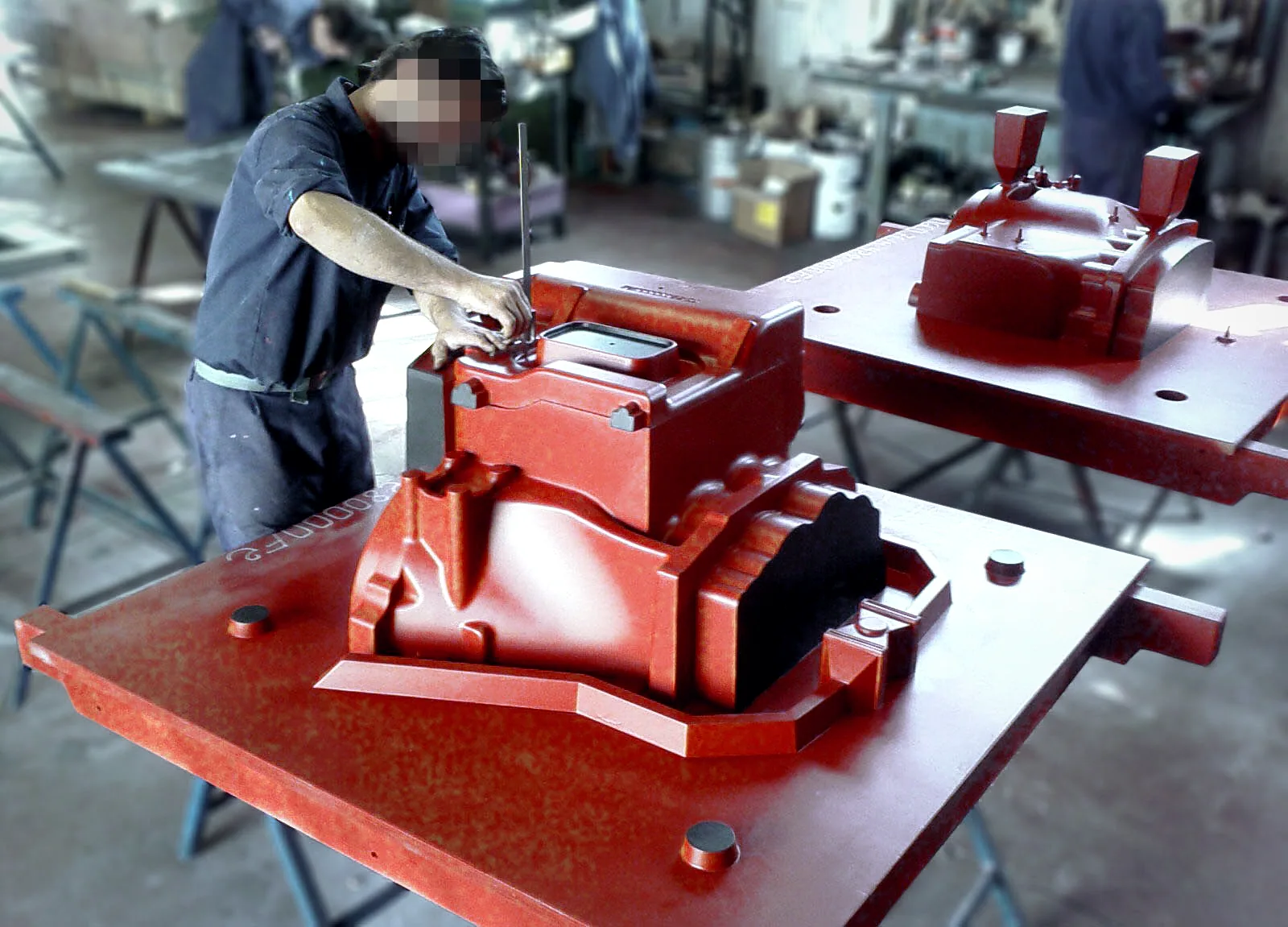
A replica of the part to be cast, which the foundry uses to leave its imprint in the sand of the mould. It is made slightly larger than the casting to compensate for the shrinkage of the metal, with draft angles so it can be removed without breaking the sand, and with core prints to support the cores. It can be made of wood, resin, polystyrene or plastic.
More information: Foundry patterns · What is a foundry pattern?
- Mould
The cavity with the shape of the part, made in sand, which the foundry prepares with the pattern and into which the metal is poured. The sand mould is broken to remove each casting; the pattern, on the other hand, is reused to make many moulds, except for lost patterns.
More information: Pattern or mould?
- Core
A sand body with the shape of an internal cavity of the part. It is made separately, in a core box, and placed inside the mould before pouring; the metal flows around it and, once it is removed, the cavity remains in the casting.
More information: Foundry patterns
- Core box
A tool, usually made of wood or resin, inside which the sand core is made. It reproduces the shape of the internal cavity of the part and can be used by hand or on core shooters. At Nocu we design and make it together with the pattern.
More information: Foundry patterns
- Core print
A projection on the pattern that is not part of the casting. It leaves in the sand the seat on which the core rests and is held inside the mould.
More information: What is a foundry pattern?
- Parting line
The plane along which the mould is opened. The mould is made in two flasks, which are separated along this line so that the pattern can be removed without breaking the sand.
More information: What is a foundry pattern?
- Draft angle
A slight taper on the walls of the pattern that allows it to be drawn from the sand without dragging or breaking it. It can be added by putting material on top of the part dimension, or subtracted by removing material from that dimension.
More information: What is a foundry pattern?
- Shrinkage
The reduction in size that the metal undergoes as it cools. This is why the pattern is made slightly larger than the part, depending on the metal to be cast, so that the casting is to size once it has cooled.
More information: What is a foundry pattern?
- Gating and feeding system
The set of channels through which the metal enters the mould: sprue, runner, ingates and feeders (risers). It carries the metal to the casting and feeds it while it solidifies.
More information: What is a foundry pattern?
Types of pattern
- Loose pattern
A one-piece pattern with the complete shape of the part, moulded entirely in one of the flasks. If it is divided into two halves along the parting line, it is called a split pattern, and each half leaves its imprint in one flask.
More information: Types of foundry patterns
- Pattern on plates
A pattern in which each half is mounted on its own plate: one for the drag and one for the cope. It is the usual way of working in machine moulding.
More information: Types of foundry patterns
- Flaskless casting pattern
A pattern mounted on wooden plates with the moulding box built in, also in wood. For this reason it does not need a metal flask for moulding.
More information: Types of foundry patterns
- Lost pattern
An expanded polystyrene (EPS) pattern that is not recovered. In lost-foam (full-mould) casting it stays buried in the sand and the metal vaporises it during pouring; in another variant the sand is moulded around it and it is broken and removed in pieces before pouring.
More information: Foundry patterns · Types of foundry patterns
Composites
- Master (pattern for composites)
A replica of the part from which the laminator makes the polyester or glass-fibre mould. It is made of wood or machinable resins and delivered with the finish the mould requires.
More information: Patterns for composites
- Direct mould
A mould machined directly from the 3D file, in wood or machinable resins, used to make composite parts without an intermediate pattern.
More information: Patterns for composites
Technologies
- Large-format additive manufacturing (LFAM)
3D printing of large parts (Large Format Additive Manufacturing). It is used for foundry patterns, moulds for composites, prototypes and end-use parts. At Nocu we print up to 2500 × 1300 × 1000 mm (about 3 m³).
More information: 3D printing and large format
- 5-axis CNC milling
Numerically controlled machining in which the tool can be oriented along five axes, making it possible to mill complex surfaces, such as propeller blades, with fewer set-ups. At Nocu we mill up to 6000 × 4000 × 1500 mm in one set-up, programmed in TEBIS.
More information: 5-axis CNC milling
- 3D scanning
Capturing the geometry of a part as a mesh or point cloud. When the scan is compared with the original CAD, a colour map shows the deviations. At Nocu we use a tracker-based scanner, without targets, for parts over 30 m³.
More information: 3D scanning and reverse engineering
- Reverse engineering
Obtaining the CAD model of an existing part from its 3D scan, for example when there are no drawings of the part or an old pattern has to be reproduced.
More information: 3D scanning and reverse engineering
Propellers
- FPP propeller (fixed pitch)
Fixed Pitch Propeller: the blades are cast in one piece with the hub or fixed to it, and their pitch cannot be changed.
More information: Propeller patterns
- CPP propeller (controllable pitch)
Controllable Pitch Propeller: the blades are made separately and rotate on the hub to change the pitch while the vessel is under way.
More information: Propeller patterns
- Ducted propeller
A propeller that works inside a nozzle, a ring with a hydrodynamic profile that surrounds it and increases thrust at low speed. It is common on tugs and fishing vessels.
More information: Propeller patterns
- CLT propeller
Contracted and Loaded Tip propeller, with end plates at the blade tips that reduce losses at the tip of the blade.
More information: Propeller patterns
Explainer videos
Need a foundry pattern?
Send us the drawing or 3D file and we will reply with a proposal.
Shall we talk about your next project?
Send us the drawing or 3D file. Our engineering department will assess the part and propose the most suitable technology.
39611 Guarnizo (El Astillero), Cantabria, Spain
The Google map only loads if you accept it, because Google Maps sets cookies.