
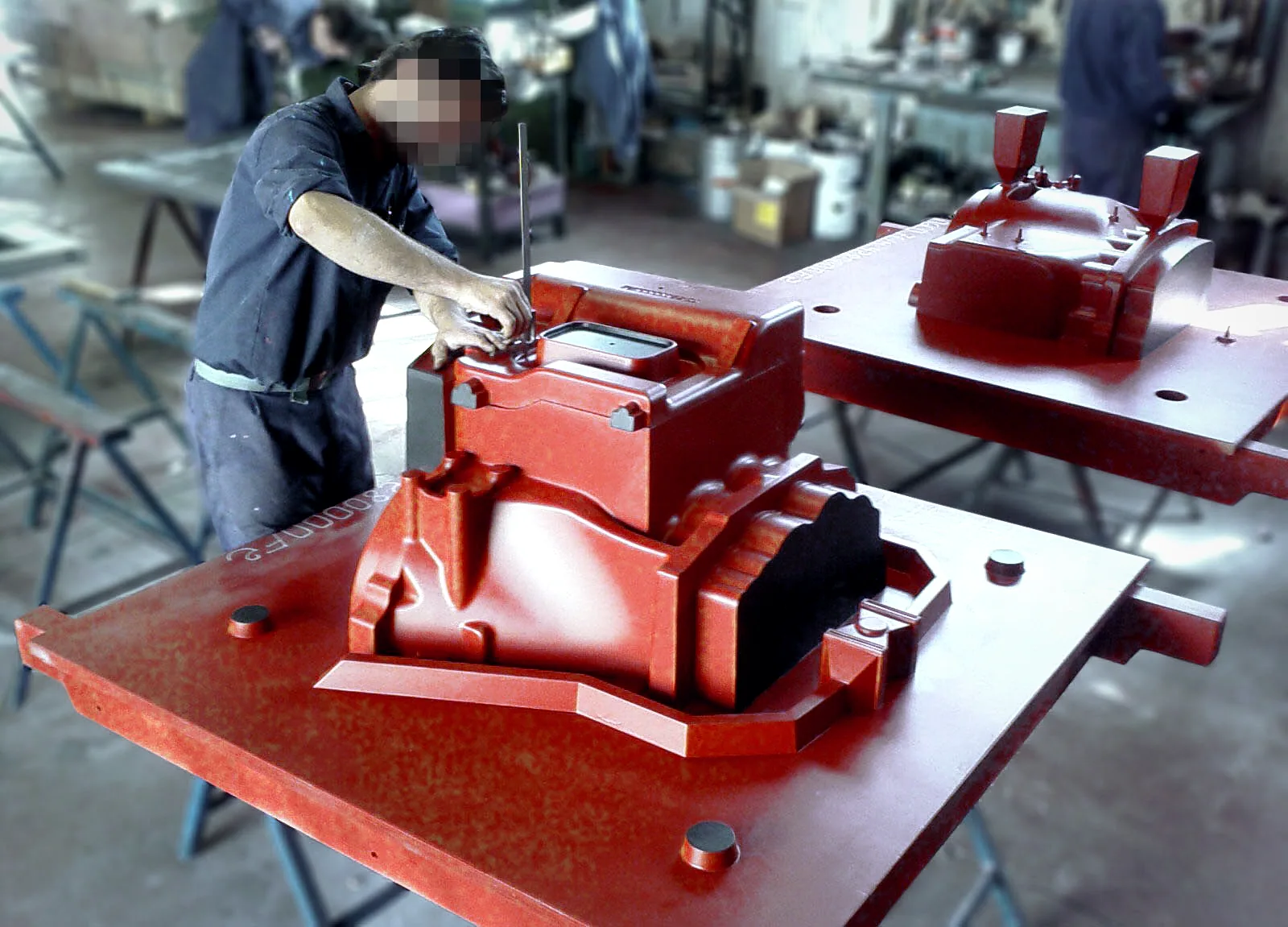
What is a foundry pattern?
A 3-minute animation that explains, step by step, what a foundry pattern is and how it is used in sand moulding: parting line, gating system, shrinkage, draft, cores and core prints.
Voice-over: synthetic voice joe (Piper).
Video transcript
What is a pattern for?
To leave the impression of the casting in the sand. That impression is the cavity the metal will later fill.
What is the parting line?
It is the plane where the mould opens. The mould is made in two flasks so they can be separated and the pattern removed without breaking the sand.
How does the metal get into the mould?
Through the gating system: sprue, runner, ingates and risers. It carries the metal to the casting and feeds it as it solidifies.
Why is the pattern larger than the casting?
Because metal shrinks as it cools. The pattern is made slightly larger so that the cold casting ends up at its correct size.
Why are the pattern walls tapered?
So it can be removed without dragging or breaking the sand. This slight taper is the draft (draft angle).
Draft added to or subtracted from size?
Added: the draft is made by adding material to the casting size. Subtracted: the draft is made by removing material from that size.
And if the casting has a hole?
A core is placed in the mould: a sand body shaped like the hole. The core is made separately, in a core box.
And how is the core held inside the mould?
With core prints: projections on the pattern that are not part of the casting. They leave seats in the sand where the core rests.
Summary
A pattern is much more than a copy of the casting.
Need a foundry pattern?
Send us the drawing or 3D file and we will reply with a proposal.
Shall we talk about your next project?
Send us the drawing or 3D file. Our engineering department will assess the part and propose the most suitable technology.
39611 Guarnizo (El Astillero), Cantabria, Spain
The Google map only loads if you accept it, because Google Maps sets cookies.